The Shifting Sands of Power: A Deep Dive into Latest Gaming PC Price vs. Performance Analysis
The world of PC gaming is a relentless arms race, a perpetual dance between cutting-edge technology and the ever-present constraint of a budget. For enthusiasts and newcomers alike, navigating the labyrinthine landscape of components, benchmarks, and price tags can be daunting. Every year, new generations of CPUs and GPUs promise unprecedented leaps in performance, often accompanied by equally impressive price tags. The core question, therefore, remains: how do we extract the maximum gaming performance for our hard-earned money in the current market?
This extensive analysis will dissect the latest trends in gaming PC hardware, providing a comprehensive price vs. performance breakdown across key components. We will explore the sweet spots, the diminishing returns, and the strategic choices that define a truly optimized gaming rig in today’s dynamic ecosystem. Our goal is to empower readers with the knowledge to make informed decisions, whether they are building a budget-friendly 1080p machine, a high-fidelity 1440p powerhouse, or an uncompromising 4K monster.
The Current Market Landscape: A Volatile but Promising Era
The gaming PC market has stabilized significantly since the tumultuous years of cryptocurrency mining booms and pandemic-induced supply chain disruptions. Graphics card prices, once inflated to absurd levels, have largely returned to (or even below) MSRP, leading to a more favorable environment for consumers. Competition between Intel and AMD in CPUs, and Nvidia and AMD in GPUs, remains fierce, driving innovation and occasionally leading to aggressive pricing strategies.
However, "value" is a moving target. While component prices might be more reasonable, the overall cost of a high-end system has undeniably increased due to inflation and the sheer technological sophistication of modern hardware. Furthermore, the rapid pace of development means that yesterday’s top-tier component can quickly become today’s mid-range, making future-proofing a complex endeavor. The influence of AI-powered upscaling technologies like NVIDIA’s DLSS and AMD’s FSR has also fundamentally altered the performance equation, allowing less powerful hardware to achieve playable frame rates at higher resolutions.
Core Components: The Heart of the Beast
Understanding the individual price-to-performance ratio of each major component is crucial before assembling a holistic build strategy.
1. Graphics Cards (GPUs): The Performance Kingpin
Without a doubt, the GPU is the single most critical component for gaming performance. It dictates the resolutions you can play at, the frame rates you can expect, and the visual fidelity you can enjoy. The current generation sees NVIDIA’s RTX 40-series battling AMD’s RX 7000-series.
NVIDIA GeForce RTX 40-Series:
- RTX 4060 / 4060 Ti: These cards target 1080p gaming, with the 4060 Ti sometimes capable of pushing into light 1440p. They offer solid rasterization performance for their price point, but their limited VRAM (8GB) can be a concern in demanding titles at higher settings, especially with ray tracing enabled. DLSS 3 Frame Generation is a significant advantage, often allowing for higher frame rates than raw power would suggest, but it introduces some latency. Price-to-performance is generally considered decent but not spectacular compared to previous generations, especially for the 4060 Ti.
- RTX 4070 / 4070 Super / 4070 Ti Super: This range is arguably the current sweet spot for 1440p gaming. The original 4070 offers excellent 1440p performance, while the 4070 Super significantly boosts performance for a relatively small price increase, making it a standout. The 4070 Ti Super, with its increased VRAM (16GB) and wider memory bus, pushes firmly into high-refresh 1440p and even respectable 4K performance, often rivaling the previous generation’s RTX 3090. These cards excel with ray tracing and leverage DLSS 3 effectively.
- RTX 4080 Super / 4090: These are the flagship cards for high-refresh 4K gaming and professional workloads. The 4080 Super offers a compelling step up from the 4070 Ti Super, bringing robust 4K capabilities. The RTX 4090 remains the undisputed performance king, offering unparalleled raw power, especially in ray tracing, but at a premium price point that puts it out of reach for most. For pure gaming, the performance delta between a 4080 Super and a 4090 is significant but comes with an even more significant price jump, marking a clear point of diminishing returns for most users.
AMD Radeon RX 7000-Series:
- RX 7600 / 7700 XT: The RX 7600 is AMD’s answer to the RTX 4060, offering solid 1080p performance with competitive rasterization. The RX 7700 XT steps up for 1440p gaming, often trading blows with the RTX 4060 Ti and sometimes even the RTX 4070 in traditional rasterization. AMD’s FSR 3 with Frame Generation offers a similar upscaling solution to DLSS 3, but its adoption rate and image quality are often seen as slightly behind NVIDIA’s.
- RX 7800 XT: This card is arguably AMD’s strongest value proposition in the current lineup. It consistently outperforms the RTX 4070 in rasterization at 1440p and often comes in at a lower price point. With 16GB of VRAM, it’s well-equipped for future games and higher texture settings. Its main drawback is generally weaker ray tracing performance compared to NVIDIA equivalents and less mature Frame Generation technology. For raw 1440p performance without heavy ray tracing, it’s a stellar choice.
- RX 7900 XT / 7900 XTX: These are AMD’s high-end offerings, targeting high-refresh 1440p and 4K gaming. The 7900 XT offers performance competitive with the RTX 4070 Ti Super in rasterization, often at a better price. The 7900 XTX is a true 4K performer, often competing with the RTX 4080 Super in traditional games, sometimes even surpassing it. Like other AMD cards, their ray tracing performance lags behind NVIDIA’s top-tier cards, but the raw power and generous VRAM (20GB for XT, 24GB for XTX) make them compelling alternatives for those prioritizing rasterization and VRAM capacity.
GPU Price vs. Performance Summary:
- Budget (1080p): RX 7600, RTX 4060. The AMD often wins on raw rasterization value.
- Mid-Range (1440p Sweet Spot): RX 7800 XT, RTX 4070 Super. The 7800 XT offers superior rasterization value, while the 4070 Super excels with ray tracing and DLSS 3. This is where personal preference for features matters most.
- High-End (High-refresh 1440p / Entry 4K): RX 7900 XT, RTX 4070 Ti Super, RX 7900 XTX. Strong contenders that deliver excellent performance, with NVIDIA maintaining a lead in ray tracing and upscaling maturity.
- Enthusiast (Uncompromising 4K): RTX 4080 Super, RTX 4090. The 4090 stands alone, but the 4080 Super offers a more "reasonable" path to high-end 4K.
2. Central Processing Units (CPUs): The Orchestrator
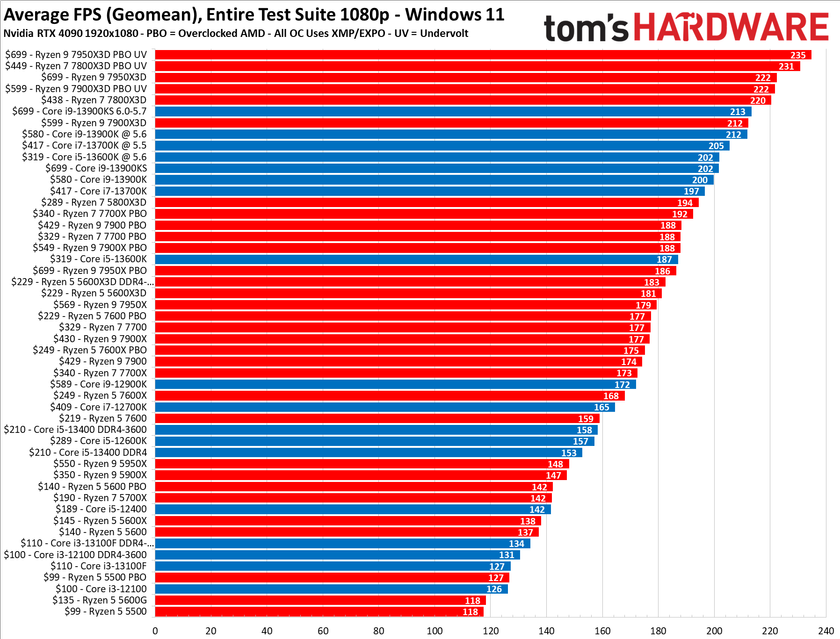
While the GPU is king for raw frames, the CPU is the brain, managing game logic, AI, physics, and feeding instructions to the GPU. For gaming, an excessively powerful CPU often yields diminishing returns beyond a certain point, especially when paired with a mid-range GPU.
Intel Core Processors:
- Core i5 (e.g., i5-13600K / 14600K): These are often the sweet spot for gaming. They offer excellent single-core performance, sufficient multi-core power, and don’t bottleneck even high-end GPUs in most games. The "K" series (unlocked for overclocking) provides flexibility, while non-K versions (e.g., i5-13400/14400) offer solid value for slightly less performance and power consumption.
- Core i7 (e.g., i7-13700K / 14700K): A step up, offering more cores and threads, which can benefit productivity tasks and very CPU-intensive games or scenarios (e.g., streaming while gaming). For pure gaming, the performance uplift over an i5 is often minor, leading to diminishing returns on investment.
- Core i9 (e.g., i9-13900K / 14900K): Top-tier processors designed for extreme multi-threaded workloads. For gaming, they offer negligible performance gains over an i7 or even a high-end i5 in most titles, making them poor value for money if gaming is the sole focus. Their high power consumption also necessitates robust cooling solutions.
AMD Ryzen Processors:
- Ryzen 5 (e.g., Ryzen 5 7600 / 7600X): Similar to the Core i5, these are fantastic gaming CPUs. The Ryzen 5 7600X offers excellent raw gaming performance, often matching or exceeding Intel’s i5 in many titles, especially when paired with fast DDR5 RAM. The non-X 7600 offers similar performance at a lower TDP and price.
- Ryzen 7 (e.g., Ryzen 7 7700X / 7800X3D): The Ryzen 7 7800X3D is a standout for gaming. Its unique 3D V-Cache technology provides a massive boost in cache-sensitive games, often making it the fastest gaming CPU available, even outperforming much more expensive Intel i9s. For pure gaming, it represents exceptional value at its price point. The 7700X is a more traditional multi-core performer, good for gaming and light productivity.
- Ryzen 9 (e.g., Ryzen 9 7900X / 7950X / 7950X3D): Like Intel’s i9, these are productivity powerhouses. The 7950X3D attempts to combine gaming prowess with multi-core might, but the 7800X3D generally offers better pure gaming value due to its simpler core layout. For most gamers, Ryzen 9 offers diminishing returns.
CPU Price vs. Performance Summary:
- Sweet Spot Gaming: Intel Core i5-13600K/14600K or AMD Ryzen 5 7600X / Ryzen 7 7800X3D. The 7800X3D is the current undisputed champion for gaming performance per dollar, especially if you’re not doing heavy productivity work.
- Platform Cost: AMD’s AM5 platform (Ryzen 7000 series) is newer and offers longer upgrade paths, but DDR5 RAM and AM5 motherboards can be slightly pricier than Intel’s LGA1700 platform (DDR4 compatible, but DDR5 is recommended for latest Intel CPUs).
3. RAM (Random Access Memory): Speed and Capacity
RAM influences how quickly your system can access data. For gaming, capacity and speed are key, but there’s a definite point of diminishing returns.
- Capacity: 16GB is the minimum for modern gaming. Many games now benefit from 32GB, especially at higher resolutions or if you run background applications. 64GB is overkill for gaming alone.
- Speed: DDR5 is the new standard, offering higher speeds than DDR4. For Intel, DDR5-6000 CL30-CL36 is a good sweet spot. For AMD’s Ryzen 7000 series, DDR5-6000 CL30 is often cited as the optimal speed due to the architecture’s "sweet spot" for its Infinity Fabric. Faster RAM exists but offers negligible real-world gaming benefits for a significant price hike.
- DDR4 vs. DDR5: If you’re building on an older Intel platform (12th/13th gen), DDR4 can still be a cost-effective option, especially if you already own some. However, for new builds, DDR5 is increasingly becoming the standard, and its prices have dropped considerably.
RAM Price vs. Performance Summary:
- Optimal Value: 32GB (2x16GB) DDR5-6000 CL30-CL36. This configuration offers excellent performance without breaking the bank.
4. Storage (SSDs): The Need for Speed
Gone are the days of mechanical hard drives for your primary game storage. NVMe SSDs are now essential for fast boot times, quick game loading, and smooth texture streaming.
- NVMe Gen4: The current sweet spot. Offers sequential read/write speeds typically in the 5000-7000 MB/s range, which is more than enough for gaming and general use. Prices have become very competitive.
- NVMe Gen3: Still viable for budget builds, offering speeds around 3000-3500 MB/s. The difference in game load times compared to Gen4 is often minimal in practice.
- NVMe Gen5: The latest and fastest, with speeds exceeding 10,000 MB/s. While impressive on paper, Gen5 drives are significantly more expensive and offer virtually no perceptible gaming benefit over Gen4. They are primarily for professional workloads that involve massive file transfers.
- Capacity: 1TB is a good minimum, but 2TB is highly recommended as game sizes continue to balloon.
Storage Price vs. Performance Summary:
- Optimal Value: 1TB or 2TB NVMe Gen4 SSD. Focus on reliable brands over chasing the absolute fastest speeds.
5. Motherboards: The Foundation
The motherboard connects all your components. Its impact on gaming performance is indirect but crucial for stability, features, and future upgradability.
- Chipsets:
- Intel: B760/B660 (mid-range, good for most gaming CPUs) or Z790/Z690 (high-end, for overclocking K-series CPUs).
- AMD: B650/B650E (mid-range, excellent value, supports CPU overclocking) or X670/X670E (high-end, for extreme overclocking, more PCIe lanes).
- Features: Look for sufficient USB ports, M.2 slots, good VRM (Voltage Regulator Module) quality (especially if using higher-end CPUs), and Wi-Fi/Bluetooth if needed. Don’t overspend on features you won’t use.
- Form Factor: ATX is standard, Micro-ATX for smaller builds, Mini-ITX for compact SFF (Small Form Factor) PCs.
Motherboard Price vs. Performance Summary:
- Optimal Value: A B-series chipset motherboard (B760 for Intel, B650 for AMD) with good VRMs and essential connectivity. Overspending here rarely translates to more frames per second.
6. Power Supply Unit (PSU): The Unsung Hero
The PSU provides stable power to all your components. Never skimp on the PSU.
- Wattage: Calculate your total system wattage and add a 20-30% buffer. GPU manufacturers often recommend minimum wattages.
- Efficiency: 80 PLUS Bronze is fine, Gold is ideal for most, Platinum/Titanium for extreme efficiency (less relevant for gaming alone).
- Modularity: Fully modular PSUs simplify cable management.
- Reliability: Stick to reputable brands with good warranties (e.g., Seasonic, Corsair, be quiet!, Cooler Master, EVGA).
PSU Price vs. Performance Summary:
- Optimal Value: An 80 PLUS Gold rated, fully modular PSU from a reputable brand, with sufficient wattage for your components plus headroom.
7. Case & Cooling: Aesthetics and Longevity
- Case: Focus on good airflow, sufficient space for your components (especially GPU length and CPU cooler height), and aesthetics. Price doesn’t always correlate with performance here.
- CPU Cooler:
- Air Coolers: Excellent value. High-end air coolers (e.g., Noctua NH-D15, DeepCool AK620/AK500, Thermalright Phantom Spirit) can rival or outperform many AIOs for less money and greater reliability. Perfect for i5/Ryzen 5/Ryzen 7 7700X.
- AIO Liquid Coolers: Offer superior cooling for high-end, overclocked CPUs (i7/i9/Ryzen 9), often look cleaner, and can allow for smaller case footprints if space is at a premium. More expensive and introduce more points of failure than air coolers. For the 7800X3D, a decent air cooler is usually sufficient.
Case & Cooling Price vs. Performance Summary:
- Optimal Value: A well-ventilated case and a robust air cooler for most gaming CPUs. Consider a 240mm or 360mm AIO for high-end, power-hungry CPUs.
Pre-Built vs. DIY: The Eternal Debate
The choice between buying a pre-built gaming PC and assembling one yourself has its own price-to-performance implications.
DIY (Do It Yourself):
- Pros: Maximum customization, often better value (you choose each component), deeper understanding of your system, easier upgrades, often higher quality components (PSU, motherboard).
- Cons: Requires time and effort for research and assembly, troubleshooting can be challenging for beginners, individual component warranties instead of a single system warranty.
Pre-Built:
- Pros: Convenience (plug-and-play), single system warranty, professional assembly, often includes OS, sometimes good deals during sales.
- Cons: Often includes lower-quality "unbranded" components (especially PSUs, RAM, motherboards), limited customization, potential for bloatware, can be more expensive than DIY for equivalent specs.
Current Market Insight: The gap in price between DIY and pre-built has narrowed considerably, especially during sales events from reputable system integrators. For those intimidated by building, a well-researched pre-built from a known brand (e.g., Origin PC, Maingear, CyberPowerPC, iBuyPower, or even some offerings from Dell Alienware/HP Omen during sales) can offer decent value. However, DIY still reigns supreme for absolute price-to-performance optimization and component quality control.
Building Tiers: Strategic Price vs. Performance Builds
Let’s put it all together with example build philosophies targeting different resolutions and budgets. Note: Prices are approximate and fluctuate widely based on region, sales, and specific models.
1. Entry-Level (1080p High Refresh / Budget 1440p) – $800 – $1200 USD
This tier focuses on delivering a smooth 1080p experience at high refresh rates (120Hz+) or a solid 1440p experience on medium-to-high settings.
- CPU: AMD Ryzen 5 7600 (non-X) or Intel Core i5-13400F/14400F.
- CPU Cooler: Stock cooler (for non-X Ryzen 5) or a basic aftermarket air cooler like Thermalright Assassin X/Spirit.
- Motherboard: AMD B650 (e.g., Gigabyte B650M DS3H) or Intel B760 (e.g., MSI PRO B760M-A).
- RAM: 32GB (2x16GB) DDR5-6000 CL30-36.
- Storage: 1TB NVMe Gen4 SSD (e.g., Crucial P5 Plus, WD Black SN770).
- GPU: AMD Radeon RX 7600 (for budget 1080p) or RX 7700 XT (for higher 1080p/entry 1440p) or NVIDIA GeForce RTX 4060 (for DLSS/RT focus).
- PSU: 650W 80+ Gold (e.g., Corsair RM650e, Seasonic Focus GX-650).
- Case: Good airflow mid-tower (e.g., Montech AIR 903 MAX, Fractal Pop Air).
Performance Expectation:
- RX 7600/RTX 4060: 1080p Ultra settings, 60-90+ FPS in most modern games.
- RX 7700 XT: 1080p Ultra settings, 90-144+ FPS; 1440p High settings, 60-80+ FPS.
2. Mid-Range (1440p High Refresh – The Sweet Spot) – $1200 – $1800 USD
This is where the best price-to-performance ratio for gaming often lies, offering an excellent balance of visual fidelity and frame rates at 1440p, which is increasingly becoming the preferred resolution for many gamers.
- CPU: AMD Ryzen 7 7800X3D (best gaming value) or Intel Core i5-13600K/14600K.
- CPU Cooler: High-end air cooler (e.g., DeepCool AK620, Thermalright Phantom Spirit 120 SE) or 240mm AIO.
- Motherboard: AMD B650 (e.g., MSI B650 GAMING PLUS WIFI) or Intel B760 (e.g., Gigabyte B760 AORUS ELITE AX).
- RAM: 32GB (2x16GB) DDR5-6000 CL30.
- Storage: 2TB NVMe Gen4 SSD (e.g., Samsung 970 Evo Plus, Crucial P5 Plus).
- GPU: AMD Radeon RX 7800 XT (superior rasterization value) or NVIDIA GeForce RTX 4070 Super (superior ray tracing, DLSS 3).
- PSU: 750W 80+ Gold (e.g., Seasonic Focus GX-750, Corsair RM750e).
- Case: Good airflow mid-tower (e.g., Lian Li Lancool 216, Fractal Design North).
Performance Expectation:
- RX 7800 XT/RTX 4070 Super: 1440p Ultra settings, 80-120+ FPS in most modern games. Excellent for high-refresh 1440p monitors. Ray tracing performance will vary, with NVIDIA having an edge.
3. High-End (High-Refresh 1440p / Entry 4K) – $1800 – $2500 USD
Pushing towards the enthusiast tier, these builds offer a no-compromise 1440p experience and a very capable entry into 4K gaming, often with high settings.
- CPU: AMD Ryzen 7 7800X3D (still the gaming king) or Intel Core i7-13700K/14700K (for more productivity).
- CPU Cooler: 240mm or 360mm AIO Liquid Cooler (e.g., Arctic Liquid Freezer II, Lian Li Galahad II) or top-tier air cooler.
- Motherboard: AMD B650 (e.g., ASUS ROG STRIX B650E-F GAMING WIFI) or Intel Z790 (e.g., MSI PRO Z790-A WIFI) if overclocking.
- RAM: 32GB (2x16GB) DDR5-6000 CL30.
- Storage: 2TB NVMe Gen4 SSD (e.g., Samsung 980 Pro, WD Black SN850X).
- GPU: AMD Radeon RX 7900 XT/XTX or NVIDIA GeForce RTX 4070 Ti Super/4080 Super.
- PSU: 850W 80+ Gold (e.g., Corsair RM850x, Seasonic Focus GX-850).
- Case: Premium airflow mid-tower (e.g., Phanteks G500A, Cooler Master HAF 700 EVO).
Performance Expectation:
- RX 7900 XT/RTX 4070 Ti Super: 1440p Ultra settings, 120-180+ FPS; 4K High settings, 60-90+ FPS.
- RX 7900 XTX/RTX 4080 Super: 1440p Ultra settings, 144-200+ FPS; 4K Ultra settings, 80-120+ FPS.
4. Enthusiast/Uncompromising (4K Max Settings) – $2500+ USD
This tier is for those who demand the absolute best, willing to pay the premium for unbridled 4K performance, often with ray tracing maxed out. Diminishing returns are very real here.
- CPU: AMD Ryzen 7 7800X3D (still great for gaming) or Intel Core i9-13900K/14900K (for ultimate multi-tasking/productivity).
- CPU Cooler: 360mm AIO Liquid Cooler (e.g., NZXT Kraken, Arctic Liquid Freezer II) is highly recommended, especially for Intel i9.
- Motherboard: High-end AMD X670E or Intel Z790 with robust VRMs and features.
- RAM: 32GB or 64GB (2x16GB or 2x32GB) DDR5-6000 CL30.
- Storage: 2TB NVMe Gen4 SSD (main drive) + 2TB secondary NVMe or SATA SSD.
- GPU: NVIDIA GeForce RTX 4090 (unrivaled performance) or AMD Radeon RX 7900 XTX (strong 4K rasterization alternative).
- PSU: 1000W+ 80+ Gold/Platinum (e.g., Corsair HX1000