The Apex Predator: A Comprehensive Review of the Latest Gaming PCs for Streaming and Gaming
The landscape of PC gaming has never been more vibrant, dynamic, or demanding. What was once a niche hobby has exploded into a global phenomenon, fueled by the rise of esports, competitive multiplayer titles, and the ubiquitous presence of content creation. Today, building or buying a PC isn’t just about playing games; for an ever-growing segment of enthusiasts, it’s about simultaneously conquering virtual worlds and sharing those triumphs (and hilarious failures) with a live audience. This dual mandate—excelling at high-fidelity gaming while seamlessly streaming to platforms like Twitch, YouTube, and Kick—requires a machine that is nothing short of an apex predator in the computing ecosystem.
This comprehensive review delves into the intricate world of the latest gaming PCs designed for both streaming and gaming. We will dissect the core components, explore the nuances of pre-built versus custom machines, highlight critical streaming peripherals, and provide insights into future-proofing your investment in this rapidly evolving technological frontier.
The Unforgiving Demands: Why a Dual-Purpose PC Needs More
Before we dive into the hardware, it’s crucial to understand why a PC capable of both high-end gaming and professional streaming needs significantly more horsepower than a machine dedicated to just one task.
Gaming Demands:
Modern games push the boundaries of graphical fidelity, physics simulations, and AI. This translates to:
- High Resolutions: 1440p and 4K are becoming standard, requiring immense GPU power.
- High Refresh Rates: Competitive gamers chase 144Hz, 240Hz, or even 360Hz monitors, demanding consistent high frame rates from the GPU and responsive CPU performance.
- Ray Tracing: Realistic lighting, shadows, and reflections are computationally intensive, primarily taxing the GPU.
- Complex Game Worlds: Open-world games with dense environments require fast data loading (storage) and substantial RAM.
Streaming Demands (on top of Gaming):
When you stream, your PC isn’t just running the game; it’s simultaneously performing several other CPU and GPU-intensive tasks:
- Video Encoding: Compressing raw game footage into a streamable format (H.264 or H.265/HEVC). This can be done by the CPU (x264) or a dedicated hardware encoder on the GPU (NVENC/AMF).
- Live Broadcast Software: Running OBS Studio, Streamlabs Desktop, or similar software, which manages overlays, alerts, chat, and directs the encoded video to the streaming platform.
- Peripherals Management: Handling inputs from webcams, microphones, capture cards, stream decks, and other devices.
- Multitasking: Keeping Discord, browser tabs, music players, and other applications open in the background.
The synergy of these demands means that a balanced, powerful system is not a luxury, but a necessity. A bottleneck in any single component can lead to dropped frames in-game, stuttering on stream, or a generally frustrating experience for both the streamer and their audience.
The Heart of the Beast: Core Components Dissected
Every component in a high-performance streaming and gaming PC plays a vital role. Understanding their functions and the latest options is key to making informed decisions.
1. The Central Processing Unit (CPU): The Brain and the Workhorse
For a dual-purpose PC, the CPU is paramount. It handles game logic, AI, physics, and crucially for streamers, the encoding process if using software-based encoding (x264). Even with hardware encoding, a powerful CPU is essential to prevent game performance degradation.
- Key Specifications: Core count, thread count, clock speed, cache size.
- Current Leaders:
- Intel: The latest 13th and 14th generation "Raptor Lake" and "Raptor Lake Refresh" CPUs (e.g., i7-13700K, i9-13900K, i7-14700K, i9-14900K) offer a hybrid architecture with performance (P) cores and efficiency (E) cores. They excel in single-core gaming performance and offer high core counts for multitasking and encoding.
- AMD: The Ryzen 7000 series (e.g., Ryzen 7 7700X, Ryzen 9 7900X, Ryzen 9 7950X) are formidable contenders, especially with their 3D V-Cache variants (e.g., Ryzen 7 7800X3D, Ryzen 9 7950X3D). These "X3D" chips offer significantly larger L3 cache, providing a noticeable boost in gaming performance, often surpassing Intel in many titles. For pure streaming power with gaming, the non-X3D Ryzen 9 chips offer high core/thread counts.
- Recommendation: For serious streaming and gaming, aim for an Intel i7/i9 (K-series for overclocking) or an AMD Ryzen 7/9. The Ryzen X3D chips are the current gaming kings, while Intel’s higher core counts can be advantageous for heavy x264 encoding, though GPU-based encoding often makes this less critical.
2. The Graphics Processing Unit (GPU): The Heart and Soul of Visuals
The GPU is arguably the most critical component for gaming performance, determining your frame rates, resolution capabilities, and graphical settings. For streamers, it also houses dedicated hardware encoders (NVENC for NVIDIA, AMF for AMD) that offload the encoding process from the CPU, allowing for minimal impact on game performance.
- Key Specifications: VRAM (Video RAM), CUDA cores (NVIDIA) / Stream Processors (AMD), clock speed, architecture.
- Current Leaders:
- NVIDIA: The RTX 40-series (Ada Lovelace architecture) reigns supreme.
- RTX 4090: The undisputed performance king, offering unparalleled 4K gaming and streaming capabilities. Ideal for no-compromise setups.
- RTX 4080 Super: Excellent 4K performance, a significant step down in price from the 4090 but still premium.
- RTX 4070 Ti Super / 4070 Super: Strong performers for 1440p high refresh rate gaming and capable 4K. Great value proposition for many.
- NVENC Encoder: NVIDIA’s dedicated hardware encoder is renowned for its efficiency and quality, making NVIDIA GPUs a strong choice for streamers.
- AMD: The RX 7000-series (RDNA 3 architecture) offers compelling rasterization performance.
- RX 7900 XTX: AMD’s flagship, offering competitive 4K rasterization performance against the RTX 4080 Super, though generally lagging in ray tracing.
- RX 7900 XT / 7800 XT: Strong 1440p and entry-level 4K options, offering excellent value.
- AMF Encoder: AMD’s encoder has improved significantly but is still generally considered to be a step behind NVENC in terms of quality and efficiency by many professional streamers.
- NVIDIA: The RTX 40-series (Ada Lovelace architecture) reigns supreme.
- Recommendation: For a premium streaming and gaming experience, an NVIDIA RTX 4070 Super or higher is highly recommended due to superior ray tracing and the industry-leading NVENC encoder. If pure rasterization performance per dollar is the priority and you’re comfortable with AMD’s encoder, the RX 7900 XTX is a strong contender.
3. Random Access Memory (RAM): The System’s Short-Term Memory
RAM is where your PC stores data that it needs to access quickly. For gaming, this includes game assets; for streaming, it involves the streaming software, browser tabs, and other background applications.
- Key Specifications: Capacity (GB), Speed (MHz/MT/s), Latency (CL).
- Current Standard: DDR5 is now the norm for modern platforms (Intel 13th/14th Gen, AMD Ryzen 7000 series).
- Recommendation:
- Capacity: 32GB is the sweet spot for serious gaming and streaming. While 16GB might suffice for gaming, the overhead of streaming software, multiple browser tabs, and other applications will quickly consume available memory, leading to stuttering or system slowdowns.
- Speed: Aim for DDR5 RAM with speeds of 6000MHz or higher and relatively tight timings (e.g., CL30 or CL32) for optimal performance on current platforms. Ensure you enable XMP/EXPO in your BIOS for the advertised speeds.
4. Storage: Speed and Capacity for Games and Recordings
Modern games are massive, and recording high-quality streams consumes vast amounts of storage space. Fast storage is crucial for quick boot times, rapid game loading, and smooth video editing.
- Key Specifications: Type (NVMe SSD, SATA SSD, HDD), Capacity (TB), Read/Write Speeds (MB/s), PCIe Generation (for NVMe).
- Current Leaders:
- NVMe SSDs: These are essential. Connected directly to the motherboard via PCIe lanes, they offer dramatically faster speeds than SATA SSDs.
- PCIe Gen4: The current mainstream standard, offering excellent performance (e.g., 5000-7000 MB/s).
- PCIe Gen5: The bleeding edge, offering even higher speeds (e.g., 10,000-14,000 MB/s), but currently more expensive and requires compatible motherboards and active cooling.
- NVMe SSDs: These are essential. Connected directly to the motherboard via PCIe lanes, they offer dramatically faster speeds than SATA SSDs.
- Recommendation:
- Primary Drive: A 1TB or 2TB NVMe PCIe Gen4 SSD for your operating system, primary games, and streaming software.
- Secondary Drive: Another NVMe SSD (1-4TB) or a large SATA SSD (2-8TB) for additional games, stream recordings, and general media storage. While HDDs offer massive capacity for cheap, their slow speeds make them unsuitable for games or active recordings.
5. Motherboard: The Backbone of the System
The motherboard connects all your components, facilitates communication, and dictates your upgrade path.
- Key Specifications: Chipset (e.g., Intel Z790, AMD X670E/B650), CPU Socket (LGA 1700 for Intel, AM5 for AMD), RAM slots (DDR5), PCIe slots, M.2 slots, USB ports, Wi-Fi capabilities.
- Recommendation: Choose a motherboard compatible with your chosen CPU. Opt for a mid-range to high-end board from reputable brands (ASUS, MSI, Gigabyte, ASRock) that offers:
- Robust VRMs (Voltage Regulator Modules) for stable power delivery to the CPU, especially if overclocking.
- Sufficient M.2 slots for NVMe SSDs (at least two, ideally three or more).
- Ample USB ports (especially USB 3.2 Gen 2/2×2 for fast peripherals).
- Wi-Fi 6E or Wi-Fi 7 and 2.5GbE Ethernet for reliable networking.
6. Power Supply Unit (PSU): The Unsung Hero
Never skimp on the PSU. It delivers clean, stable power to all your components. A poor PSU can lead to instability, component damage, and system crashes.
- Key Specifications: Wattage, 80 Plus Efficiency Rating (Bronze, Gold, Platinum, Titanium), Modularity (fully modular is best for cable management).
- Recommendation:
- Wattage: Calculate your system’s power draw (online calculators help) and add 150-250W headroom for future upgrades and transient power spikes (especially with high-end GPUs). For top-tier systems (RTX 4090/4080 Super, i9/Ryzen 9), aim for 850W to 1200W.
- Efficiency: An 80 Plus Gold rating is a good balance of efficiency and cost. Platinum or Titanium offer even better efficiency but come at a premium.
- Modularity: Fully modular PSUs allow you to connect only the cables you need, drastically improving cable management and airflow.
7. Cooling: Keeping Your Components Chill
High-performance CPUs and GPUs generate significant heat. Effective cooling is crucial to prevent thermal throttling (where components reduce their performance to avoid overheating) and ensure longevity.
- Types: Air Coolers, All-in-One (AIO) Liquid Coolers, Custom Liquid Loops.
- Recommendation:
- High-End Air Coolers: Excellent performance for many CPUs (e.g., Noctua NH-D15, DeepCool AK620). Quieter and generally more reliable than AIOs in the long run.
- AIO Liquid Coolers: For top-tier CPUs (i9, Ryzen 9), a 240mm or 360mm AIO is often necessary to maintain optimal temperatures, especially if overclocking. Look for models from Arctic, Lian Li, NZXT, Corsair.
- Case Fans: Ensure your PC case has good airflow and enough high-quality case fans (intake and exhaust) to move air effectively.
8. PC Case: The Enclosure and Airflow Architect
More than just aesthetics, your PC case plays a crucial role in cooling, cable management, and component compatibility.
- Key Considerations: Airflow (mesh front panels are excellent), size (ATX mid-tower is common), support for radiators/fans, cable management features, aesthetics.
- Recommendation: Prioritize airflow. Cases from brands like Lian Li, Fractal Design, NZXT, Corsair, and Phanteks offer excellent options with good thermals and build quality. Ensure it can comfortably fit your chosen GPU and CPU cooler.
Pre-Built vs. Custom Build: The Age-Old Dilemma
Once you understand the components, the next big decision is whether to buy a pre-built gaming PC or assemble one yourself.
Pre-Built Gaming PCs: Convenience at a Premium
Pros:
- Convenience: Ready to use out of the box, no assembly required.
- Warranty: Often a single system warranty for the entire PC, simplifying troubleshooting.
- Support: Access to customer support from the system builder.
- Software: Sometimes includes pre-installed software, though this can also be bloatware.
- Sales: Can sometimes find excellent deals during sales events.
Cons:
- Component Compromises: Builders may cut corners on less visible components (PSU, RAM speed, cheaper motherboard) to save costs.
- Limited Customization: Less control over specific brands or models of components.
- Bloatware: Often comes with pre-installed software you don’t need.
- Higher Cost: Generally more expensive than building an equivalent PC yourself, component for component.
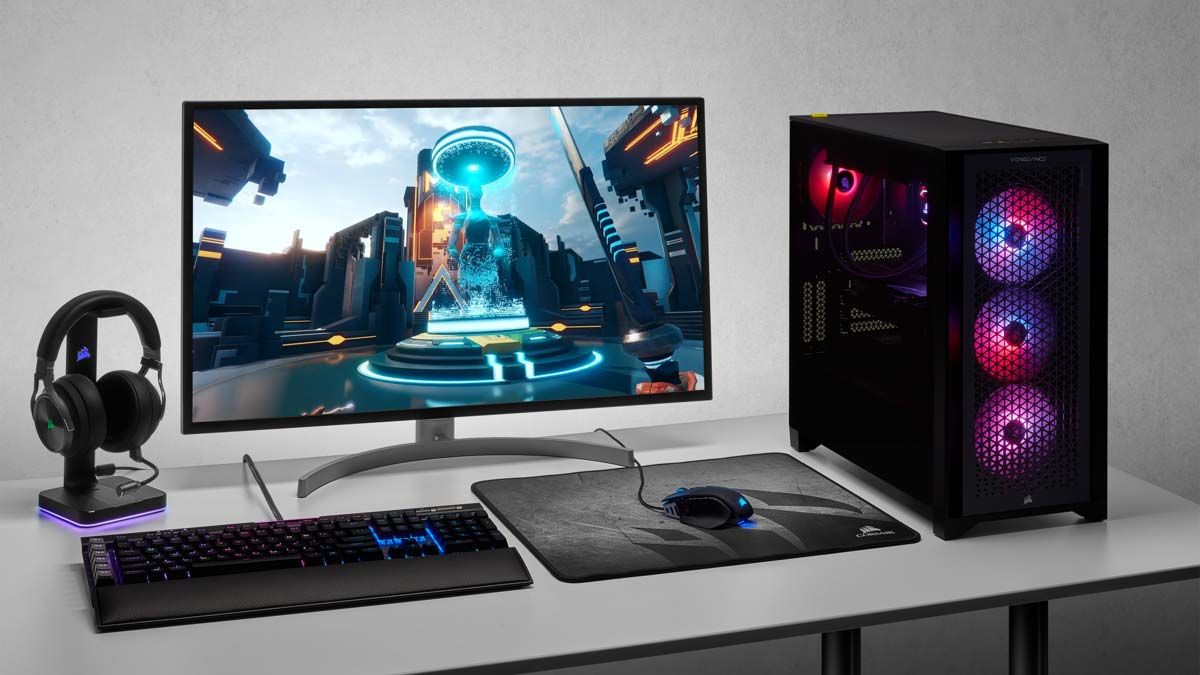
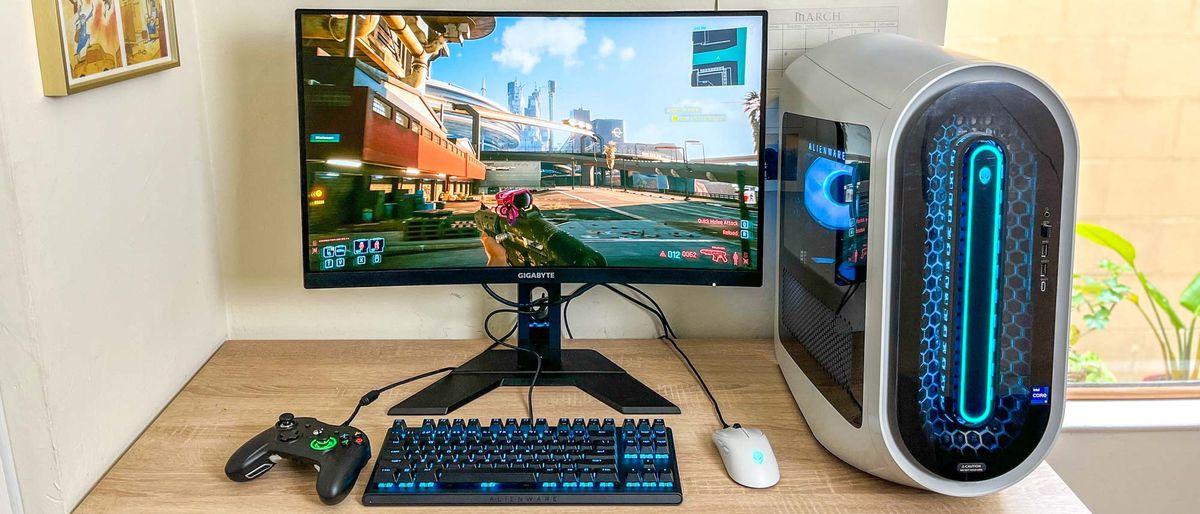
Reputable Brands: Alienware (Dell), Omen (HP), ROG (ASUS), Legion (Lenovo), NZXT BLD, CyberPowerPC, iBUYPOWER, Corsair Vengeance.
Custom PC Build: The DIY Route for Control and Value
Pros:
- Ultimate Customization: Choose every single component to perfectly match your needs and budget.
- Better Value: Often yields a more powerful system for the same price, or a cheaper system for the same performance.
- Learning Experience: Gaining knowledge about PC hardware can be empowering and help with future upgrades/troubleshooting.
- No Bloatware: A clean Windows installation.
- Quality Control: You control the quality of each component.
Cons:
- Time & Effort: Requires research, assembly time, and potential troubleshooting.
- Individual Warranties: Each component has its own warranty, which can complicate returns.
- Potential for Mistakes: Risk of damaging components during assembly if inexperienced.
- No Single Point of Support: You are your own tech support (or rely on online communities).
Recommendation: If you’re comfortable with a bit of research and hands-on work, building your own PC offers the best value and control. If convenience and a single point of warranty are paramount, a reputable pre-built system from a known brand is a good option, but be diligent about checking component specifications.
The Streaming Advantage: Beyond the Box
A powerful PC is the foundation, but a true streaming setup requires additional gear to elevate your content.
-
Capture Card:
- When Needed: Primarily for a dual-PC streaming setup (where one PC plays the game and the other streams) or for console streaming. Not typically needed for single-PC streaming if your GPU has a good hardware encoder.
- Types: Internal PCIe cards (e.g., Elgato Game Capture HD60 Pro, 4K60 Pro) offer lower latency, external USB cards (e.g., Elgato Cam Link 4K, HD60 S+) offer portability.
-
Microphone:
- Impact: Crucial for clear communication. A good mic is more important than a good webcam for listener engagement.
- Types: USB microphones (e.g., Blue Yeti, Rode NT-USB+, HyperX QuadCast) are easy to set up. XLR microphones (e.g., Shure SM7B, Rode Procaster) offer superior audio quality but require an audio interface (mixer/preamp).
-
Webcam / Camera:
- Impact: Visuals for viewer connection.
- Types: High-quality webcams (e.g., Logitech C920, StreamCam, Razer Kiyo Pro) are affordable. Mirrorless cameras or DSLRs (with a capture card like Elgato Cam Link 4K) offer professional-grade video but are significantly more expensive and complex.
-
Lighting:
- Impact: Good lighting drastically improves webcam quality.
- Types: Ring lights, key lights (softboxes), fill lights.
-
Stream Deck / Control Panel:
- Impact: Programmable buttons for quick scene switching, sound effects, chat commands, and more.
- Examples: Elgato Stream Deck (various sizes), Loupedeck Live.
-
Headset:
- Impact: Clear in-game audio and communication with teammates.
- Considerations: Comfort, sound quality, microphone quality (though a dedicated mic is usually better).
-
Monitor:
- Impact: Your window into the game.
- Considerations: Resolution (1080p, 1440p, 4K), refresh rate (144Hz, 240Hz+), panel type (IPS for colors, TN for speed), response time, adaptive sync (G-Sync/FreeSync). For a dual-purpose PC, a high-refresh-rate 1440p or 4K monitor is ideal.
-
Networking:
- Impact: Stable internet connection is paramount for streaming.
- Recommendation: Always use a wired Ethernet connection to your router. Wi-Fi can introduce latency and packet loss, leading to dropped frames on stream. Ensure you have sufficient upload speed from your ISP (at least 10-20 Mbps upload for 1080p/60fps streaming).
Future-Proofing Your Investment
Technology moves fast. While true future-proofing is impossible, you can make choices that extend your PC’s lifespan and upgradeability:
- Over-spec Slightly: Don’t just meet minimum requirements; aim higher, especially for CPU, GPU, and RAM.
- Robust PSU: A higher wattage PSU provides headroom for future, more power-hungry components.
- Modern Motherboard: Choose a motherboard with the latest generation chipset, ample M.2 slots (PCIe Gen4/Gen5), and a good array of I/O ports.
- DDR5 RAM: Ensure your platform uses DDR5 for current and future compatibility.
- Ample Storage: Start with enough fast storage, but ensure there’s room for more NVMe drives.
- Modular Design: A good case with excellent cable management and airflow will make future upgrades easier.
Budget Considerations: The Spectrum of Performance
Building a top-tier gaming and streaming PC can be a significant investment. Here’s a general breakdown of what to expect:
- Entry-Level (Still Capable): $1,000 – $1,500: Focus on 1080p high refresh rate gaming or 1440p at moderate settings, with basic streaming capabilities (likely relying heavily on GPU encoder). You’ll find CPUs like Ryzen 5/Intel i5, GPUs like RTX 3060/4060 or RX 6700XT/7600XT.
- Mid-Range (Sweet Spot): $1,500 – $2,500: Excellent 1440p gaming at high refresh rates, and solid 1080p/60fps streaming. This tier often features CPUs like Ryzen 7/Intel i7, and GPUs like RTX 4070 Super/4070 Ti Super or RX 7800 XT/7900 XT. This is where many streamers find the best balance of performance and cost.
- High-End (No Compromises): $2,500 – $4,000+: Dominate 4K gaming, high refresh rate 1440p, and professional-grade streaming. This territory includes CPUs like Ryzen 9/Intel i9 and GPUs like RTX 4080 Super/4090 or RX 7900 XTX. This is for those who demand the absolute best performance and future-proofing.
Remember that prices fluctuate, and sales can significantly impact your final cost. Don’t forget to factor in the cost of peripherals (monitor, keyboard, mouse, microphone, webcam) which can add hundreds, if not thousands, to the total budget.
Conclusion: The Ultimate Battle Station Awaits
Building or buying the latest gaming PC for streaming and gaming is an exhilarating journey into the cutting edge of personal computing. It’s a testament to the convergence of passion, technology, and creativity. By understanding the intricate demands of both tasks and making informed choices about each core component, you can craft a machine that not only delivers breathtaking gaming experiences but also empowers you to share those moments with the world in crystal-clear fidelity.
The "apex predator" PC isn’t just about raw power; it’s about a harmonious balance of components, each working in concert to provide a seamless, high-performance experience. Whether you choose the path of meticulous self-assembly or the convenience of a carefully selected pre-built system, the reward is an unparalleled digital playground and a robust platform for your streaming aspirations. The future of gaming and content creation is here, and with the right machine, you’re ready to conquer it.