Revolutionizing Heat: A Deep Dive into New Gaming PC Cooling System Efficiency
In the relentless pursuit of graphical fidelity and processing power, modern gaming PCs push the boundaries of technology. With every generational leap, CPUs and GPUs become more potent, capable of rendering stunning worlds and executing complex computations at blistering speeds. However, this immense power comes with an equally immense challenge: heat. Unchecked thermal accumulation can lead to performance throttling, reduced component lifespan, system instability, and an overall diminished gaming experience.
This article delves into the exciting advancements in new gaming PC cooling systems, offering a comprehensive review of their efficiency. We’ll explore the technologies driving these innovations, dissect the metrics used to evaluate their performance, and provide insights into how gamers can optimize their cooling solutions for peak efficiency.
The Imperative of Efficient Cooling in Modern Gaming PCs
Before we dive into the "how," let’s reiterate the "why." Efficient cooling is not merely a luxury; it’s a fundamental requirement for a high-performance gaming PC.
- Performance Sustenance: Modern CPUs and GPUs employ "boost" algorithms (e.g., Intel Turbo Boost, AMD Precision Boost, NVIDIA GPU Boost) that allow them to operate above their base clock speeds as long as thermal limits are not exceeded. An efficient cooler enables these components to maintain higher boost clocks for longer durations, translating directly into smoother gameplay and higher frame rates. Conversely, poor cooling leads to thermal throttling, where the hardware automatically reduces its clock speed to prevent overheating, causing noticeable performance drops.
- Component Longevity: Heat is the enemy of electronics. Prolonged exposure to high temperatures accelerates the degradation of semiconductor materials, capacitors, and other delicate components. An effective cooling system significantly extends the lifespan of expensive CPUs, GPUs, and even motherboards, protecting your investment.
- System Stability: Overheating can cause system crashes, freezes, and unexpected shutdowns. A stable thermal environment ensures reliable operation, preventing frustrating interruptions during intense gaming sessions.
- Acoustics (Noise Level): While performance is paramount, noise can significantly impact the user experience. Efficient coolers often achieve excellent thermal dissipation with lower fan speeds, resulting in a much quieter PC. This is especially crucial for gamers who prefer an immersive, distraction-free environment.
- Overclocking Potential: For enthusiasts who push their hardware beyond factory specifications, a robust cooling solution is non-negotiable. Overclocking directly increases heat output, and a highly efficient cooler is essential to unlock higher, stable overclocks.
The Evolution of Cooling: What’s "New"?
While the fundamental principles of heat transfer (conduction, convection, radiation) remain constant, the application and refinement of these principles in PC cooling have seen significant innovation. The "new" in cooling systems isn’t always about revolutionary physics, but rather the ingenious engineering that maximizes efficiency within practical constraints.
We can categorize new cooling advancements into three primary areas: advanced air cooling, sophisticated All-in-One (AIO) liquid cooling, and highly optimized custom liquid loops.
1. Advanced Air Cooling: The Silent Giants
Air cooling, the oldest and most widespread method, has undergone a remarkable transformation. Far from simple heatsinks, modern high-end air coolers are engineering marvels.
- Massive Heatsink Arrays: Contemporary air coolers feature incredibly dense fin stacks, often in dual-tower configurations (e.g., Noctua NH-D15, be quiet! Dark Rock Pro 4). These massive structures provide an immense surface area for heat dissipation. The sheer volume of aluminum or copper fins allows for greater heat exchange with ambient air.
- Refined Heat Pipe Technology: Heat pipes are critical. Newer designs utilize more heat pipes, often directly touching the CPU Integrated Heat Spreader (IHS) for more efficient heat transfer (Direct Touch Heatpipes). Advances in wick structures and internal fluids within the heat pipes improve their thermal conductivity and phase-change efficiency, moving heat rapidly from the CPU base to the fin stack. Some high-end designs even incorporate vapor chambers at the base, which act like a flattened, super-efficient heat pipe, spreading heat across a larger area before it enters the main heat pipes.
- Optimized Fan Design: The fans are equally important. Manufacturers are investing heavily in fan blade geometry, motor design, and bearing technology.
- Blade Design: Aerodynamically optimized blades generate higher static pressure to push air through dense fin stacks while minimizing turbulence and noise.
- Motor & Bearings: Fluid Dynamic Bearings (FDB), Magnetic Levitation (ML), and Self-Stabilizing Oil-pressure Bearings (SSO2) offer longer lifespans, reduced friction, and significantly quieter operation at higher RPMs compared to older sleeve or ball bearings.
- RPM Control: Precise PWM (Pulse Width Modulation) control allows motherboards or dedicated software to finely tune fan speeds based on temperature, optimizing the balance between cooling performance and noise.
- Offset Designs: To address compatibility issues with tall RAM modules, many modern air coolers feature offset designs, shifting the heatsink slightly to accommodate memory slots without sacrificing cooling potential.
Efficiency Insight: The efficiency of modern air coolers lies in their ability to dissipate vast amounts of heat passively (through a large surface area) and actively (through highly efficient fans) with remarkable acoustic performance. They offer an excellent performance-to-cost ratio and unparalleled reliability due to fewer moving parts and no risk of liquid leaks.
2. All-in-One (AIO) Liquid Cooling: The Mainstream Performer
AIO liquid coolers have become incredibly popular, bridging the gap between air cooling and complex custom loops. They offer superior cooling performance over most air coolers in a more compact and aesthetically pleasing package.
- Larger Radiators: The trend is towards larger radiators – 280mm, 360mm, and even 420mm – which provide substantially more surface area for heat exchange compared to the standard 120mm or 240mm units of yesteryear. Thicker radiators with higher fin density also contribute to better dissipation.
- Improved Pump Designs: Companies like Asetek (who license their designs to many brands like Corsair, NZXT, Asus) have continuously refined their pump technology. Newer generations feature more powerful motors, optimized impeller designs, and quieter operation. Many manufacturers also develop their own pump designs (e.g., Arctic’s AIOs with larger, quieter pumps and integrated VRM fans), focusing on higher flow rates and longevity.
- Enhanced Cold Plates: The cold plate, which sits directly on the CPU, has seen improvements. Micro-skived copper fins and larger contact areas maximize heat absorption from the CPU. Some designs incorporate a split-flow manifold or jet plate to direct coolant flow more efficiently over the hot CPU area.
- Low-Permeability Tubing: Modern AIOs use tubing made from materials like EPDM rubber, which significantly reduces coolant evaporation over time, extending the maintenance-free lifespan of the unit.
- Integrated Software Control & Aesthetics: Beyond performance, AIOs now often integrate sophisticated software control for pump speed, fan curves, and extensive RGB lighting customization. This allows users to fine-tune their cooling based on workload and aesthetic preferences.
Efficiency Insight: AIOs excel at rapidly transferring heat away from the CPU via the liquid, then dissipating it over a larger, often remote, radiator surface. Their efficiency comes from the high thermal capacity of liquid and the ability to move heat quickly to a larger dissipation area that might not be directly above the CPU. They generally offer a better performance-to-noise ratio than high-end air coolers, especially in situations with high, sustained CPU loads.
3. Custom Loop Liquid Cooling: The Ultimate Enthusiast Solution
For the absolute peak in cooling performance, aesthetic customization, and the quietest operation under load, custom liquid cooling loops remain king. While not "new" in concept, the components and integration have reached new levels of sophistication.
- High-Performance Components:
- Powerful Pumps: D5 and DDC pumps are standard, offering exceptional flow rates and head pressure, crucial for pushing coolant through multiple blocks and radiators.
- Large, Thick Radiators: Custom loops can accommodate multiple radiators of various sizes (up to 480mm or larger) and thicknesses, often in push-pull fan configurations, providing unparalleled heat dissipation capacity.
- Full-Cover GPU Blocks: These blocks cool not only the GPU die but also the VRAM and VRMs, drastically reducing GPU temperatures and allowing for higher overclocks.
- Monoblocks: For extreme CPU and motherboard VRM cooling, monoblocks cover both components, offering comprehensive thermal management.
- Advanced Coolants: Specialized coolants offer excellent thermal conductivity, anti-corrosive properties, and anti-algae/biocide agents to ensure loop longevity and performance.
- Smart Control Systems: Modern custom loops often integrate flow meters, multiple temperature sensors (coolant, air), and dedicated controllers that communicate with software. This allows for dynamic pump and fan control based on real-time coolant temperatures, optimizing efficiency and noise.
- Material Science: The use of nickel-plated copper blocks, high-quality O-rings, and robust fittings ensures durability and leak prevention.
Efficiency Insight: Custom loops offer the highest thermal capacity and transfer rate. Their efficiency stems from the ability to scale cooling capacity with multiple, large radiators and blocks, effectively isolating heat from core components and dissipating it over a vast area. This results in the lowest component temperatures and the greatest overclocking headroom, often with whisper-quiet operation.
4. Emerging and Exotic Technologies (Brief Mention)
While not mainstream for gaming PCs, other technologies are being explored:
- Peltier (Thermoelectric Coolers – TECs): These can achieve sub-ambient temperatures, but condensation is a major concern for typical PC builds, and they are energy-intensive.
- Immersion Cooling: Submerging components in dielectric fluid (like mineral oil) offers incredible cooling but is extremely niche, complex, and not practical for most gamers.
- Phase Change Cooling: Similar to a refrigerator compressor, these systems can achieve extremely low temperatures but are noisy, bulky, and generally reserved for extreme overclocking benchmarks.
Measuring Cooling System Efficiency: Key Metrics and Methodologies
Evaluating the efficiency of a cooling system requires a systematic approach and understanding of key metrics.
-
Delta T (ΔT): The True Indicator:
- This is the most crucial metric. ΔT represents the temperature difference between the component being cooled (CPU/GPU) and the ambient air temperature of the room. A lower ΔT indicates a more efficient cooler, as it means the cooler is maintaining lower component temperatures relative to its environment.
- Example: If your CPU is 70°C and the room is 25°C, ΔT = 45°C. If a better cooler brings the CPU down to 60°C in the same room, ΔT = 35°C, indicating significantly improved efficiency.
-
TDP Handling Capacity (Thermal Design Power):
- Manufacturers often rate coolers by the maximum TDP (in Watts) they can effectively dissipate. While useful, it’s often a guideline. Real-world performance can vary based on the CPU’s actual heat output and case airflow.
-
Noise-to-Performance Ratio:
- An efficient cooler isn’t just about raw temperature numbers; it’s about achieving those temperatures quietly. This ratio evaluates how well a cooler performs at various noise levels (measured in decibels, dB(A)). A cooler that keeps temperatures low while remaining quiet is highly efficient.
-
Testing Methodologies:
- Synthetic Stress Tests: Tools like Prime95 (CPU), AIDA64 (CPU, FPU, cache), Cinebench (CPU rendering), FurMark (GPU), and 3DMark (GPU) push components to their absolute thermal limits, providing worst-case scenario data.
- Real-World Gaming Benchmarks: Monitoring temperatures during demanding games (e.g., Cyberpunk 2077, Microsoft Flight Simulator) provides a practical understanding of efficiency under typical gaming loads.
- Controlled Environment: Testing should ideally be done in a consistent ambient temperature to ensure comparable results.
-
Monitoring Tools:
- Software like HWMonitor, HWiNFO64, MSI Afterburner, NZXT CAM, and Corsair iCUE allow users to monitor CPU/GPU temperatures, clock speeds, fan RPMs, and power draw in real-time.
Factors Influencing Overall System Cooling Efficiency
The cooling system doesn’t operate in a vacuum. Its efficiency is heavily influenced by other elements within the PC build.
-
Case Airflow and Design:
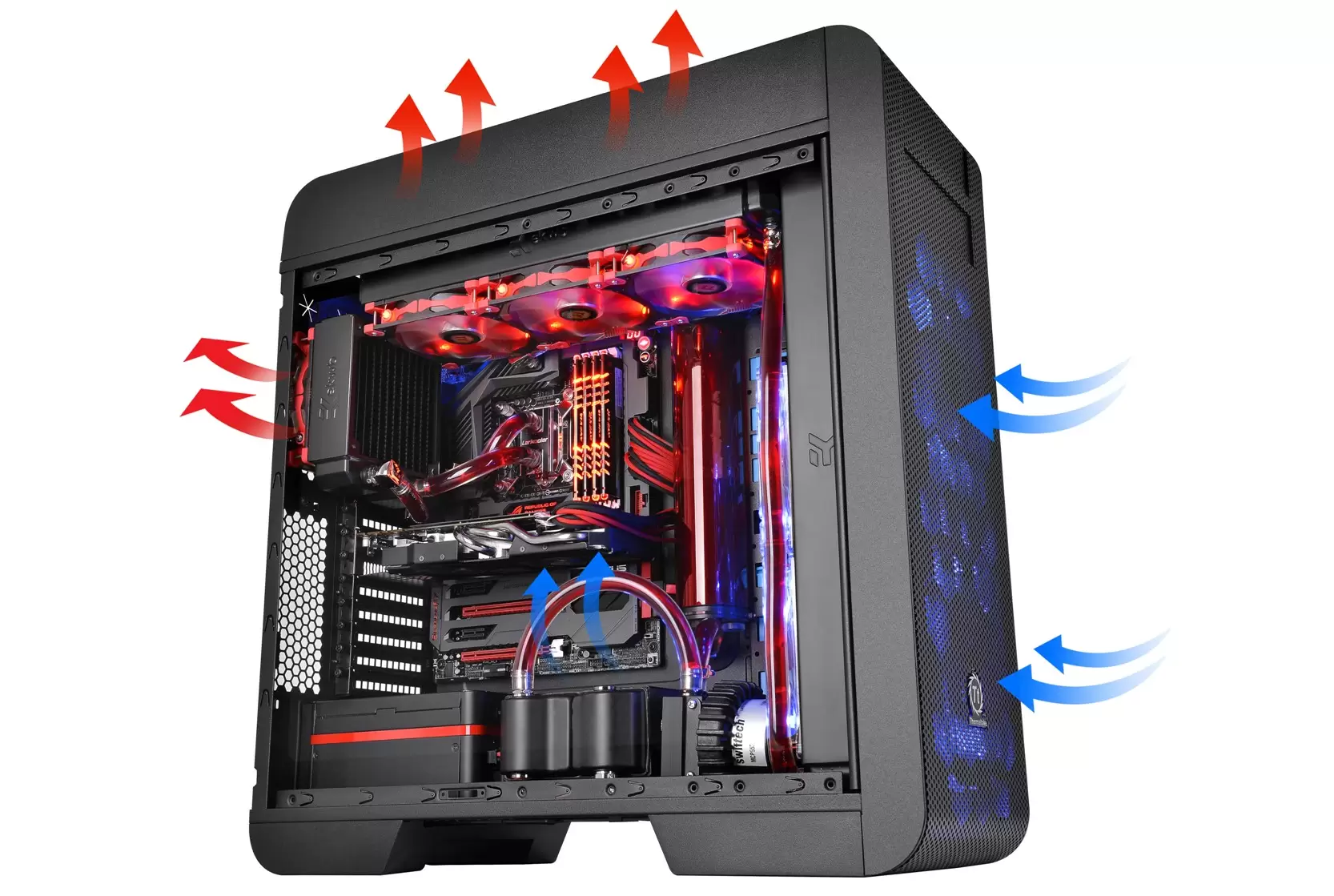
- Positive/Negative Pressure: A slightly positive pressure (more intake than exhaust) helps prevent dust buildup, while a negative pressure (more exhaust) can improve heat extraction but may draw in more dust.
- Fan Placement and Type: Strategic placement of intake and exhaust fans, combined with using appropriate fan types (high static pressure for radiators/dense heatsinks, high airflow for unrestricted paths), is crucial.
- Mesh vs. Solid Panels: Cases with mesh front panels and ample ventilation offer significantly better airflow than those with solid front panels, directly impacting internal ambient temperatures and cooler performance.
- Cable Management: Poor cable management can obstruct airflow paths, creating hot spots and reducing overall cooling efficiency.
-
Thermal Paste Application:
- The thin layer of thermal paste between the CPU/GPU die and the cooler’s cold plate is vital for efficient heat transfer. Proper application (pea method, line method, X method) and using high-quality thermal paste can shave off several degrees.
-
Fan Curves and Software Control:
- Properly configured fan curves that dynamically adjust fan speeds based on component temperatures can optimize the balance between cooling and noise. Many motherboard BIOS settings and cooler software suites allow for this customization.
-
Ambient Room Temperature:
- This is often overlooked but critical. A cooler can only dissipate heat to the ambient air. If your room is hot, your PC components will naturally run hotter.
-
Dust Accumulation:
- Dust acts as an insulator, significantly reducing the efficiency of heatsinks and radiators. Regular cleaning is essential for sustained performance.
Comparative Review: Air vs. AIO vs. Custom Loop Efficiency
Let’s briefly compare the efficiency profiles of the "new" cooling solutions:
- Advanced Air Cooling:
- Efficiency: High-end air coolers are remarkably efficient for their cost and simplicity. They can often rival 240mm AIOs and sometimes even 280mm AIOs in raw thermal performance, especially on CPUs with lower core counts. Their efficiency shines in their reliability and low acoustic profile for a given thermal load.
- Best For: Gamers prioritizing reliability, low maintenance, excellent performance-to-cost ratio, and a quiet system without the complexities or risks of liquid.
- AIO Liquid Cooling:
- Efficiency: Generally offers superior thermal performance over most air coolers, particularly with larger radiators (360mm+), especially for high-core-count CPUs or heavily overclocked systems. They excel at moving heat away from the CPU quickly and dissipating it over a larger, often externally mounted, surface.
- Best For: Gamers seeking top-tier performance, aesthetic appeal (cleaner look around the CPU socket), easier installation than custom loops, and often a better noise-to-performance ratio than air for very high heat loads.
- Custom Loop Liquid Cooling:
- Efficiency: Unmatched. Provides the absolute best thermal performance, capable of cooling multiple high-power components (CPU, GPU, VRMs) simultaneously to the lowest possible temperatures, even under extreme overclocks. Its efficiency lies in its massive thermal dissipation capacity and the ability to customize every aspect for optimal flow and heat exchange.
- Best For: Enthusiasts demanding the ultimate in cooling performance, silence, maximum overclocking potential, and extensive aesthetic customization, who are comfortable with the higher cost and complexity.
Conclusion: The Future is Cool
The landscape of PC gaming cooling systems is more vibrant and efficient than ever before. From the silent powerhouses of advanced air coolers to the sleek performance of AIO liquid solutions and the ultimate thermal mastery of custom loops, gamers have an unprecedented array of choices.
The "new" in cooling efficiency isn’t just about raw power; it’s about smarter designs, better materials, refined manufacturing processes, and intelligent software integration that together deliver superior thermal performance with reduced noise and enhanced reliability.
As CPU and GPU architectures continue to evolve, demanding even more from cooling solutions, we can anticipate further innovations: perhaps more widespread integration of vapor chambers in air coolers, even larger and more efficient AIO radiators, AI-driven fan and pump control that predicts thermal loads, and potentially more consumer-friendly exotic cooling methods.
Ultimately, the most efficient cooling system is one that perfectly balances your specific hardware’s thermal demands with your budget, aesthetic preferences, and tolerance for noise and complexity. By understanding the advancements in these systems and the factors that influence their efficiency, gamers can ensure their high-powered rigs remain cool, stable, and ready to deliver peak performance for years to come. Investing in a quality cooling solution is not just about keeping temperatures down; it’s about unlocking the full potential of your gaming PC.