The Apex Predator of Pixels: A Deep Dive into the Ultimate 2025 Gaming PC
The year 2025 is not just another tick on the calendar; it marks a significant inflection point in the evolution of PC gaming. What was once considered bleeding-edge in 2023 or even 2024 has matured, converged, and been supercharged by an unrelenting march of innovation, particularly in the realm of Artificial Intelligence. The ultimate gaming PC of 2025 is not merely faster; it’s smarter, more immersive, and an almost clairvoyant partner in delivering unparalleled gaming experiences.
This review delves into the hypothetical, yet highly probable, specifications, performance, and overall ethos of the top-tier gaming PC that enthusiasts and professionals will be coveting as the mid-point of the decade arrives. We’ll explore the silicon titans, the memory maestros, the storage speed demons, and the entire ecosystem that defines the zenith of digital entertainment.
The Heart of the Beast: CPUs and Their Intelligent Cores
By 2025, the CPU landscape will have seen another generation or two of advancements from both Intel and AMD, with a heavy emphasis on hybrid architectures and integrated AI acceleration.
Intel’s "Nova Lake" (or successor): Intel’s trajectory, solidified by architectures like Meteor Lake and Arrow Lake, points towards increasingly sophisticated tiled designs. By 2025, we anticipate "Nova Lake" or its direct successor to be the flagship. These CPUs will likely feature an even more robust mix of performance (P) cores, efficient (E) cores, and ultra-low-power LP E-cores integrated within the SoC tile. The key differentiator will be the greatly enhanced Neural Processing Unit (NPU) — a dedicated AI accelerator. This NPU won’t just handle Windows Copilot tasks; it will actively offload specific game engine computations, physics simulations, and even dynamic content generation, freeing up the P-cores for raw instruction execution. Expect higher IPC gains, further refined thread scheduling, and potentially more cores than previous generations, perhaps pushing towards 32 threads or more in consumer flagships. Integrated graphics, while improved, will still take a backseat to discrete GPUs for serious gaming.
AMD’s Zen 5/Zen 6 "X3D" Series: AMD’s prowess in gaming CPUs, particularly with its 3D V-Cache (X3D) technology, will likely continue its dominance. By 2025, we’ll be seeing the full maturation of Zen 5 and potentially the introduction of Zen 6. The Zen 5 architecture, with its anticipated IPC uplift and further refined core design, coupled with several hundred megabytes of stacked L3 cache, will offer unparalleled in-game performance. These "X3D" variants will maintain their competitive edge, delivering higher average and 1% low framerates across a vast array of titles, especially those sensitive to cache latency. AMD might also integrate its own forms of AI acceleration, perhaps leveraging its existing compute units more effectively or introducing dedicated blocks, but their primary focus for gaming will remain raw core performance and the magic of 3D V-Cache.
Verdict on CPUs: For pure gaming, especially at high refresh rates, an AMD Zen 5/6 X3D variant will likely offer the slight edge due to its gaming-centric cache design. However, Intel’s Nova Lake will be a more balanced chip, excelling in productivity, streaming, and leveraging its NPU for broader AI-driven tasks, including future game engines that heavily utilize AI acceleration. The ultimate 2025 gaming PC might choose either, depending on the user’s broader workload.
The Pixel Pushers: GPUs – The True Game Changers
This is where the magic truly happens, and 2025 will witness a new generation of graphics cards that redefine visual fidelity and performance, heavily leaning into AI-driven rendering.
NVIDIA’s GeForce RTX 5000 Series (Blackwell/Rubin Architecture): NVIDIA will likely be on its "Blackwell" or even "Rubin" architecture by 2025, representing a monumental leap from the current Ada Lovelace. Expect significant advancements across the board:
- Ray Tracing Cores: Fourth or fifth-generation RT Cores will offer several times the ray-tracing performance, making path tracing in games a mainstream reality, not just a niche, performance-intensive feature. Global illumination, reflections, and refractions will be indistinguishable from reality.
- Tensor Cores: These will be even more central. DLSS (Deep Learning Super Sampling) will evolve to version 4 or 5, not just offering superior upscaling and frame generation, but potentially incorporating AI-driven asset enhancement, real-time texture generation, and even dynamic environment adjustments based on player interaction. We might see "Neural Rendering" becoming a standard feature, where AI actively reconstructs frames with incredible detail from minimal input.
- Shader Cores: A massive increase in CUDA cores, running at higher clock speeds, possibly leveraging chiplet designs for the highest-end cards, will ensure unparalleled rasterization performance.
- VRAM: The flagship RTX 5090 (or whatever it’s called) will likely boast 32GB or more of GDDR7 memory, running at incredibly high bandwidths, crucial for 4K and 8K gaming with ultra-high texture settings and complex path tracing.
- Power Consumption: While performance will soar, power consumption will also remain a concern, necessitating robust PSUs. Efficiency per watt, however, will see significant improvements.
AMD’s Radeon RX 8000/9000 Series (RDNA 4/RDNA 5): AMD will be fiercely competitive, pushing its RDNA architecture to new heights.
- Ray Tracing: RDNA 4 and RDNA 5 will likely close much of the remaining gap with NVIDIA in ray tracing performance, offering dedicated hardware acceleration that is far more efficient than previous generations.
- FidelityFX Super Resolution (FSR): FSR 4 or 5 will mature significantly, becoming a more direct competitor to DLSS, potentially leveraging dedicated AI blocks within the GPU for better image quality and more sophisticated frame generation. AMD might also introduce its own forms of neural rendering or content generation.
- Rasterization: AMD will likely continue its strength in raw rasterization performance per dollar, offering excellent value. High VRAM configurations will be standard, with top-tier cards potentially matching or exceeding NVIDIA’s offerings.
- Chiplet Design: AMD has pioneered chiplet designs in CPUs, and by 2025, we could see high-end Radeon GPUs fully embracing multi-chip module (MCM) designs, allowing for scalable performance and potentially more cost-effective manufacturing of ultra-high-end cards.
Intel’s Arc "Celestial/Druid" Series: Intel will be the dark horse. By 2025, their third or fourth generation of Arc GPUs will have matured considerably.
- XeSS: Intel’s XeSS upscaling technology will be highly refined and broadly adopted.
- Performance: While unlikely to challenge the absolute top-tier from NVIDIA and AMD, Intel could carve out a very strong niche in the mid-range and upper-mid-range, offering compelling performance per dollar, especially with improved driver stability and feature sets. Their integrated AI capabilities might also find unique applications in specific games.
Verdict on GPUs: The ultimate 2025 gaming PC will undoubtedly feature a flagship NVIDIA RTX 5000 series card (e.g., RTX 5090) or AMD Radeon RX 9000 series card. The choice will depend on specific game optimizations and ecosystem preferences, but both will offer mind-bending performance, effortlessly running games at 4K max settings with path tracing enabled and targeting high refresh rates (120Hz-240Hz).
The Memory and Storage Nexus: Speed Beyond Limits
RAM (Random Access Memory): DDR5 will be the undisputed standard, but speeds will have dramatically increased. DDR5-8000MHz will be common, with enthusiasts pushing towards DDR5-9000MHz or even DDR6 making its debut in specialized high-end platforms. Capacities will range from 32GB as a baseline for serious gaming, with 64GB becoming increasingly popular for demanding games, streaming, and content creation. Lower latencies (e.g., CL32 or lower) will further enhance performance.
Storage (NVMe SSDs): PCIe Gen 5 NVMe SSDs will be the standard for primary game drives, with speeds easily exceeding 12,000 MB/s sequential reads and writes. More importantly, random read/write performance will see significant gains, crucial for instant loading and seamless texture streaming. PCIe Gen 6 might even make an appearance in ultra-high-end boards, pushing theoretical limits even further. Capacities will grow, with 4TB and 8TB NVMe drives becoming affordable and common for storing vast game libraries. Microsoft’s DirectStorage 2.0 (or its successor) will be fully integrated into game engines, allowing GPUs to directly access SSD data, bypassing CPU bottlenecks and enabling truly instant loading screens.
The Foundation: Motherboards, Cooling, and Power
Motherboards: These will be robust, supporting the latest CPU sockets, DDR5/DDR6, and PCIe Gen 5/6. Expect integrated Wi-Fi 7, 10 Gigabit Ethernet, and an abundance of USB4 (Thunderbolt 5 equivalent) ports. VRM (Voltage Regulator Module) designs will be incredibly sophisticated to handle the power demands of next-gen CPUs, and many will feature integrated AI for system monitoring, fan curve optimization, and even intelligent overclocking.
Cooling: With increased power comes increased heat. Large All-In-One (AIO) liquid coolers (420mm radiators) will be commonplace for CPUs, while top-tier GPUs will feature massive, multi-fan heatsinks or integrated AIO solutions. Custom liquid cooling loops will remain the choice for ultimate performance and aesthetics, often incorporating exotic fluids and smart sensors. AI-driven fan curves and pump speeds, based on real-time game load and system thermals, will ensure optimal cooling without excessive noise.
Power Supplies (PSUs): ATX 3.1 or even ATX 4.0 compliant PSUs will be mandatory, offering robust power delivery for transient spikes from GPUs. Wattages of 1200W-1600W will be standard for high-end systems, with the 12V-2×6 power connector (successor to 12VHPWR) fully matured and standardized. Efficiency ratings (80 Plus Titanium) will be paramount to manage energy consumption.
The Enclosure: Chassis and Aesthetics
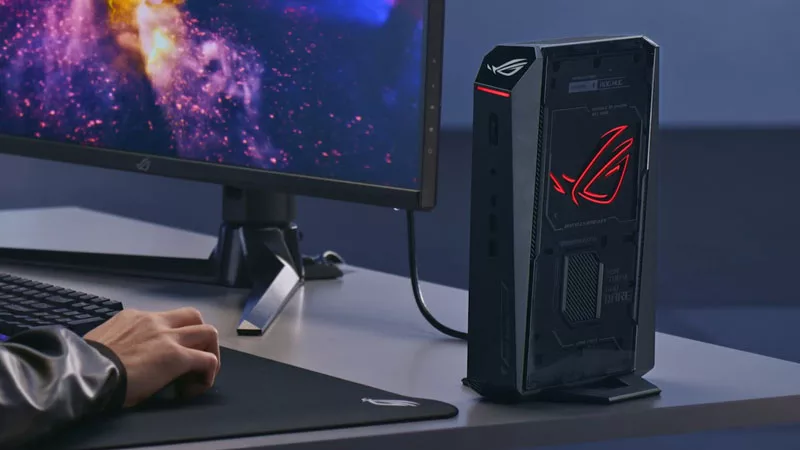
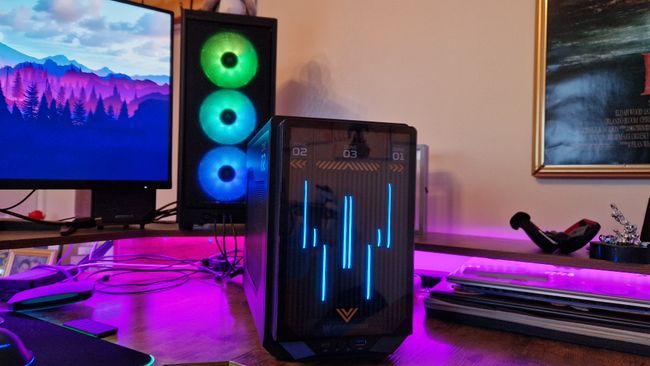
Chassis designs will prioritize airflow above all else, often featuring mesh front panels, multiple large fan mounts, and intelligent cable management solutions. Tempered glass side panels will still be popular, showcasing meticulously built interiors. RGB lighting will continue to be prevalent, but with more sophisticated, customizable, and often AI-synchronized patterns that react to in-game events or system thermals. Modularity and tool-less design will be key features.
The Immersive Experience: Beyond the Box
Displays: The ultimate 2025 gaming PC demands a display that can keep up.
- 4K 240Hz+ OLED: This will be the sweet spot. QD-OLED and WOLED panels will offer incredible contrast, vibrant colors, perfect blacks, and near-instant response times. High refresh rates will provide silky-smooth motion.
- 8K 120Hz+: While still niche, 8K monitors will become more viable, especially with the raw power of 2025 GPUs and advanced upscaling technologies.
- HDR: DisplayHDR 1400 or higher will be standard, delivering breathtaking dynamic range.
- VRR: G-Sync Ultimate or FreeSync Premium Pro will ensure tear-free, stutter-free gaming.
Peripherals: High-fidelity, ultra-low-latency wireless peripherals will dominate.
- Mice: Sub-1ms wireless response, 26,000+ DPI sensors, lightweight designs.
- Keyboards: Magnetic switches, customizable actuation points, advanced haptic feedback.
- Headsets: Immersive 3D audio (spatial audio), high-resolution drivers, crystal-clear AI-enhanced microphones for communication.
- VR/AR: More advanced standalone headsets will be available, but PC-tethered VR will offer unparalleled fidelity, potentially with higher resolutions, wider FOVs, and more sophisticated haptic gloves/suits.
Software and Operating System: Windows 12 or 13 will be deeply integrated with AI, offering system-wide performance optimizations, predictive resource allocation, and advanced security features. Game launchers will be smarter, and cloud gaming integration will be seamless. AI will play a role in dynamic difficulty scaling, intelligent NPC behavior, and even procedural content generation within games.
The AI Revolution: A Paradigm Shift in Gaming
This is arguably the most significant aspect of the 2025 gaming PC. AI will permeate every layer of the gaming experience:
- Rendering and Upscaling: Beyond DLSS/FSR, AI will reconstruct entire frames, enhance textures, and even intelligently fill in details that were never explicitly rendered, leading to visuals previously unimaginable.
- NPC Behavior: AI will drive more believable and dynamic non-player characters, offering complex interactions, adaptive strategies, and emergent behaviors that make each playthrough unique.
- Procedural Generation: AI will dynamically generate vast, detailed worlds, quests, and storylines on the fly, offering infinite replayability.
- System Optimization: The PC itself will use AI to dynamically overclock, manage power, adjust fan curves, and prioritize resources based on the specific game being played and the user’s preferences.
- Personalization: AI will learn player habits, suggest content, adapt game mechanics, and even tailor the narrative to individual preferences.
- Accessibility: AI-driven accessibility features, such as real-time voice command translation or dynamic UI adjustments, will make gaming more inclusive.
Performance Benchmarking (Hypothetical)
Let’s imagine some scenarios for the ultimate 2025 gaming PC:
- Cyberpunk 2077 (Path Tracing, Max Settings, DLSS 5.0 Performance Mode): Effortless 4K 120-144 FPS.
- Future AAA Title (e.g., "The Matrix Awakens" equivalent, full path tracing, AI-generated assets): 4K 90-120 FPS.
- Competitive FPS (e.g., Valorant, CS2): 4K 360 FPS+ (limited by CPU and game engine).
- 8K Gaming (Upscaled via DLSS 5.0, Max Settings): 8K 60-90 FPS in demanding titles.
The key will be the ability to run any game at max settings with all graphical enhancements (including path tracing) at high refresh rates on a 4K display without compromise.
Price and Value
The ultimate 2025 gaming PC will undoubtedly carry a premium price tag, likely in the range of $4,000 – $7,000+ USD, depending on specific component choices, regional pricing, and manufacturer markups. However, for that investment, users will receive a machine that is not just powerful but also intelligently designed to deliver the best possible gaming experience for years to come. The value proposition lies in its unparalleled performance, immersive capabilities, and the inherent future-proofing provided by its advanced AI integration and cutting-edge hardware.
Who is it For?
This PC is for:
- Hardcore Enthusiasts: Those who demand the absolute best performance and visual fidelity.
- Competitive Gamers: Who want every possible frame and the lowest latency.
- Streamers & Content Creators: Who need robust performance for both gaming and heavy multi-tasking.
- Early Adopters: Those eager to experience the bleeding edge of AI-driven gaming.
- Developers: Creating the next generation of games.
Conclusion: The Dawn of Intelligent Gaming
The ultimate 2025 gaming PC is more than just a collection of powerful components; it’s a testament to the synergistic evolution of hardware and artificial intelligence. It represents a future where games aren’t just rendered but are intelligently crafted and optimized in real-time, delivering levels of immersion, realism, and dynamic gameplay previously confined to science fiction. From the AI-accelerated CPUs and GPUs to the blazing-fast storage and intelligent cooling, every aspect of this machine is designed to be an apex predator of pixels, ready to transport players into digital worlds with unprecedented fidelity and responsiveness. The year 2025 promises not just faster gaming, but fundamentally smarter, more adaptive, and breathtakingly realistic gaming experiences for those who dare to embrace the future.