The Dawn of a New Era: Best Prebuilt Gaming PCs 2025 – A Comprehensive Comparison with the Present
The gaming landscape is an ever-shifting tapestry woven with threads of innovation, pushing the boundaries of realism, immersion, and raw performance. As we stand on the cusp of 2025, the horizon promises a breathtaking leap forward in gaming PC technology, making the "best" of today potentially a mid-range contender of tomorrow. This extensive article will delve into the anticipated best prebuilt gaming PCs of 2025, providing a meticulous comparison with the cutting-edge systems available in late 2023 and early 2024. We’ll explore the generational advancements in components, the evolving trends in design and features, and what gamers can expect from various price tiers in this exciting future.
The Current Apex (Late 2023 / Early 2024): A Benchmark for Comparison
To truly appreciate the future, we must first understand the present. The current high-end prebuilt gaming PCs are formidable machines, capable of delivering stunning 4K gaming experiences with ray tracing enabled. These systems are typically characterized by:
- CPUs: Intel’s 13th and 14th Gen Core i7/i9 processors (e.g., i7-13700K, i9-14900K) or AMD’s Ryzen 7000 series, particularly the X3D variants (e.g., Ryzen 7 7800X3D, Ryzen 9 7950X3D), offering exceptional core counts and single-thread performance.
- GPUs: NVIDIA’s RTX 40 series (RTX 4070 Ti, RTX 4080, RTX 4090) or AMD’s RX 7000 series (RX 7800 XT, RX 7900 XT, RX 7900 XTX). The RTX 4090 stands as the undisputed king of performance, offering unparalleled 4K ray tracing capabilities.
- RAM: DDR5 memory, typically 32GB to 64GB, running at speeds ranging from 5600MHz to 7200MHz.
- Storage: PCIe Gen 4 NVMe SSDs, with capacities of 1TB to 4TB, offering blistering fast load times.
- Cooling: High-performance AIO liquid coolers for CPUs and robust air cooling solutions for GPUs.
- Power Supplies: ATX 3.0 compatible PSUs, often 850W to 1200W, to handle the power demands of modern GPUs.
- Connectivity: Wi-Fi 6E, Bluetooth 5.3, and a plethora of USB 3.2 ports.
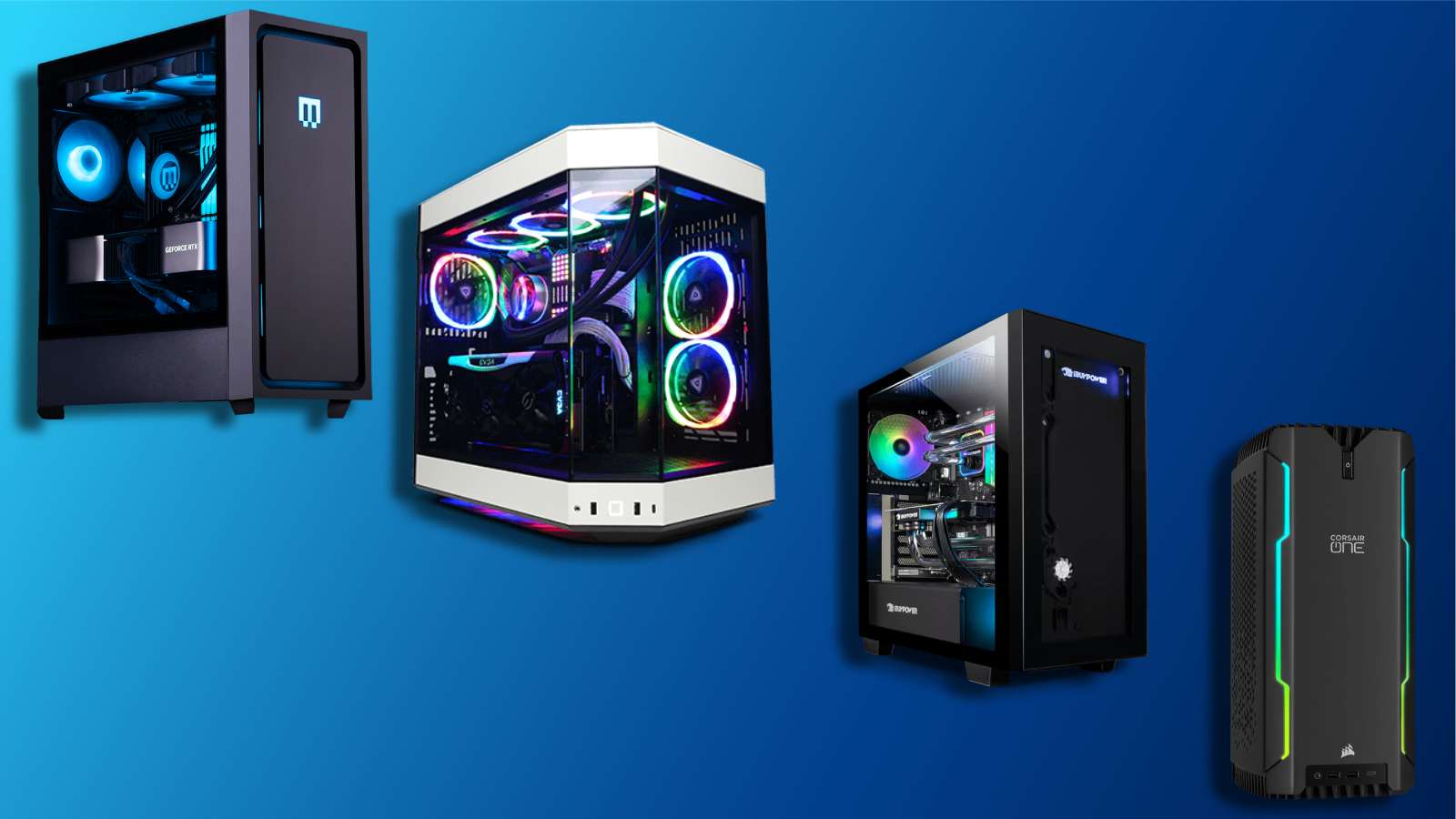
These systems excel at driving high-refresh-rate 1440p and 4K monitors, providing fluid gameplay even in the most demanding titles. They represent the peak of what is currently achievable for mainstream gaming enthusiasts, often priced between $2,000 and $4,000+ for top-tier configurations from brands like Alienware, Origin PC, Falcon Northwest, iBUYPOWER, and CyberPowerPC.
Glimpse into 2025: Anticipated Technologies and Trends
The year 2025 will not simply be an incremental update; it’s poised to be a period of significant generational leaps across all major PC components. Here’s what we anticipate:
1. Central Processing Units (CPUs)
- Intel: We expect the full rollout of Intel’s Arrow Lake architecture, potentially featuring a disaggregated tile-based design, moving beyond the current monolithic die. Arrow Lake is projected to bring significant improvements in IPC (Instructions Per Cycle), higher core counts (especially efficiency cores), and enhanced integrated graphics. Crucially, it will likely feature a more robust NPU (Neural Processing Unit) for AI workloads, becoming increasingly relevant for OS-level features and game optimizations.
- AMD: AMD will likely be well into its Zen 5 and potentially even Zen 5 X3D processor lineup. Zen 5 is rumored to offer substantial IPC gains over Zen 4, alongside improved power efficiency and potentially higher clock speeds. The X3D variants, with their stacked V-Cache, will continue to dominate gaming performance, offering an even larger cache for game data. AMD’s integrated RDNA graphics will also see a bump, making budget systems more capable.
Comparison with 2024: 2025 CPUs will offer a noticeable generational leap, with 15-25% better raw performance per dollar, significantly improved multi-threading capabilities, and dedicated AI acceleration becoming standard, not just a high-end feature. The focus will shift from just raw clock speed to intelligent core scheduling and power efficiency.
2. Graphics Processing Units (GPUs)
- NVIDIA: The RTX 50 series (Blackwell architecture) is expected to be the star of 2025. This generation is rumored to bring a massive increase in CUDA core count, significantly more advanced RT (Ray Tracing) cores, and even more powerful Tensor Cores for AI upscaling technologies like DLSS. We anticipate a substantial generational performance uplift, potentially 50-70% over the RTX 40 series in certain scenarios, especially with ray tracing and path tracing. VRAM capacities are also expected to increase across the board.
- AMD: AMD’s RDNA 4 architecture will directly compete with NVIDIA’s offerings. While specific details are scarce, RDNA 4 is expected to refine its ray tracing capabilities, boost raw rasterization performance, and likely introduce more sophisticated FSR (FidelityFX Super Resolution) implementations. AMD might focus on a stronger price-to-performance ratio, particularly in the mid-range and high-end segments.
- Intel: Intel’s Arc GPUs will likely see a significant maturation with their next generation, offering competitive performance in the entry-to-mid-range market, potentially even challenging AMD and NVIDIA in value propositions.
Comparison with 2024: GPUs in 2025 will redefine high-fidelity gaming. The RTX 5090 (or its equivalent) could push path tracing into mainstream viability at 4K. Even mid-range 2025 GPUs might outperform current-gen high-end cards, making technologies like full ray tracing and complex AI upscaling accessible to a wider audience without massive performance penalties.
3. Random Access Memory (RAM)
- DDR5 Dominance: DDR5 will be the undisputed standard across all but the most budget-conscious systems. Speeds will likely range from 6400MHz to 8000MHz+ out of the box, with tighter timings becoming more common.
- Potential DDR6 Whispers: While unlikely to be mainstream by 2025, the early development or even niche availability of DDR6 could begin to surface in enthusiast platforms, hinting at future capabilities.
Comparison with 2024: While DDR5 is prevalent now, 2025 will see higher speeds as standard, better compatibility, and potentially lower latency, contributing to overall system responsiveness and higher minimum frame rates.
4. Storage Solutions
- PCIe Gen 5 NVMe SSDs: PCIe Gen 5 SSDs, currently a niche high-end offering, will become mainstream for primary drives. Speeds of 10GB/s to 14GB/s will be common, drastically reducing load times and improving game asset streaming.
- Increased Capacities: 2TB and 4TB NVMe SSDs will be the standard for gaming PCs, with 8TB options becoming more affordable.
Comparison with 2024: While Gen 4 is fast, Gen 5 will cut load times by another significant margin, making game worlds feel even more seamless. The increased standard capacity will be a welcome relief for gamers dealing with ever-growing game sizes.
5. Cooling, Power, and Connectivity
- Cooling: AIO liquid coolers will become standard in most mid-to-high-end prebuilts, with larger radiators (360mm or even 420mm) to handle hotter CPUs. Custom liquid cooling loops will remain a premium offering for extreme enthusiasts. GPU cooling solutions will become even more sophisticated, with larger heatsinks and multiple fans.
- Power Supplies: ATX 3.0 will be the absolute standard, with higher wattage PSUs (1000W-1600W) becoming common in high-end builds to support the power-hungry next-gen GPUs.
- Connectivity: Wi-Fi 7 will be prevalent, offering significantly faster wireless speeds and lower latency. Thunderbolt 5, with its massive bandwidth, could start appearing on high-end motherboards. USB4 Gen 3×2 (80Gbps) will be more common.
Comparison with 2024: Better cooling and more robust power delivery will ensure optimal performance and stability for more demanding components. Wi-Fi 7 will provide a tangible upgrade for wireless gamers, reducing latency and download times.
Best Prebuilt Gaming PCs 2025: Tiered Comparison
Now, let’s project what the "best" prebuilt gaming PCs will look like across different price points in 2025, comparing them to their 2024 counterparts.
1. Entry-Level / Budget Gaming PCs (Under $1200)
- 2024 Equivalent: Typically features an Intel Core i5 12th/13th Gen or AMD Ryzen 5 5000/7000 series, paired with an NVIDIA RTX 3050/4060 or AMD RX 6600/7600. Capable of 1080p high settings at 60+ FPS in most games, or 1440p low/medium settings.
- 2025 Prediction: This tier will see a massive leap. Expect Intel Arrow Lake Core i3/i5 or AMD Zen 5 Ryzen 5 processors, paired with GPUs equivalent to or exceeding today’s RTX 4060 Ti / RX 7700 XT. This means smooth 1080p gaming at high refresh rates (120-144Hz) with medium ray tracing, and competent 1440p gaming at medium settings. Integrated graphics from both Intel and AMD will be powerful enough for esports titles and older games at 1080p. DDR5 6400MHz+ RAM (16GB) and 1TB PCIe Gen 4 SSDs will be standard.
- Best Brands (Likely): CyberPowerPC, iBUYPOWER, Skytech Gaming, NZXT BLD. These brands excel at offering value-focused builds with good component selection.
2. Mid-Range Gaming PCs ($1200 – $2000)
- 2024 Equivalent: Often features an Intel Core i7 13th/14th Gen or AMD Ryzen 7 7000 series (non-X3D), with an RTX 4070 / 4070 Ti or RX 7800 XT / 7900 XT. This segment is the current sweet spot for high-refresh-rate 1440p gaming and entry-level 4K.
- 2025 Prediction: This tier will become the new sweet spot for high-refresh-rate 1440p gaming with full ray tracing, and excellent 4K gaming at high settings. Expect Intel Arrow Lake Core i5/i7 or AMD Zen 5 Ryzen 7 processors (potentially X3D variants becoming more affordable), paired with GPUs equivalent to or surpassing today’s RTX 4080 / RX 7900 XTX. Think NVIDIA RTX 5070 / 5070 Ti or AMD RDNA 4 equivalent. 32GB of DDR5 7200MHz+ RAM and 2TB PCIe Gen 5 SSDs will be standard. Cooling will be robust, with 240mm/280mm AIOs becoming common.
- Best Brands (Likely): Same as above, but also HP Omen, Dell Alienware (potentially more competitive in this segment), CLX Gaming. These brands often offer better aesthetics and potentially superior build quality in this price range.
3. High-End Gaming PCs ($2000 – $3000)
- 2024 Equivalent: These are formidable machines, often housing an Intel Core i7/i9 13th/14th Gen or AMD Ryzen 7/9 7000X3D, coupled with an RTX 4080 / 4090 or RX 7900 XTX. They are built for uncompromising 4K gaming at max settings, often pushing beyond 60 FPS even with ray tracing.
- 2025 Prediction: This tier will deliver uncompromised 4K gaming at very high refresh rates (120Hz+) with full path tracing enabled. We’ll see Intel Arrow Lake Core i7/i9 or AMD Zen 5 Ryzen 7/9 X3D processors, paired with GPUs like the NVIDIA RTX 5080 / 5080 Ti or AMD RDNA 4 high-end equivalents. 32GB or 64GB of DDR5 7600MHz+ RAM and 2TB-4TB PCIe Gen 5 SSDs will be the norm. Premium 360mm AIO cooling for the CPU and excellent airflow will be standard. Expect sophisticated RGB lighting and custom cable management.
- Best Brands (Likely): Origin PC, Falcon Northwest, Maingear, Digital Storm, NZXT BLD (high-end configurations). These brands offer superior customization, build quality, and often better customer support.
4. Enthusiast / No-Compromise Gaming PCs (Over $3000)
- 2024 Equivalent: The pinnacle of current PC gaming, featuring the absolute best of everything: Intel Core i9 14900K or AMD Ryzen 9 7950X3D, paired with an NVIDIA RTX 4090. These systems target bleeding-edge performance, often for specific use cases like competitive 4K gaming at max settings, streaming, and content creation simultaneously.
- 2025 Prediction: This tier will be defined by next-generation path tracing, AI-driven performance, and massive future-proofing. Expect the absolute top-tier Intel Arrow Lake Core i9 or AMD Zen 5 Ryzen 9 X3D processors, potentially even with dual-CPU configurations becoming more viable for extreme workloads (though unlikely for pure gaming). The GPU will be the NVIDIA RTX 5090 (or whatever NVIDIA’s flagship is called) or AMD’s equivalent, possibly featuring even more VRAM (32GB+). 64GB+ of the fastest DDR5 RAM (8000MHz+) and multiple PCIe Gen 5 SSDs (4TB+) will be standard. Custom liquid cooling loops for both CPU and GPU will be common. These systems will incorporate advanced features like integrated display panels for monitoring, premium chassis materials, and extensive software suites for optimization.
- Best Brands (Likely): Falcon Northwest, Origin PC, Maingear, Digital Storm, Puget Systems (for extreme workstations with gaming capabilities). These are boutique builders known for their craftsmanship, extreme performance, and personalized service.
Key Comparison Points: 2024 vs. 2025
-
Raw Performance & Efficiency:
- 2024: Excellent 4K performance, but often at the cost of high power draw, especially with the RTX 4090. Ray tracing can still be very demanding.
- 2025: Significant uplift in raw FPS across all resolutions. Next-gen GPUs will handle ray tracing and even path tracing with much greater efficiency, making these graphical enhancements less impactful on frame rates. Both CPUs and GPUs will offer better performance per watt.
-
Price-to-Performance Ratio:
- 2024: Current generation components have settled in price, offering good value, especially in the mid-range.
- 2025: Initially, cutting-edge 2025 components might carry a premium. However, the performance jump will be so substantial that a 2025 mid-range PC could outperform a 2024 high-end PC for the same price, offering a much better overall value proposition.
-
AI Integration & Upscaling:
- 2024: DLSS 3 (Frame Generation) and FSR 3 are current highlights, providing significant frame rate boosts.
- 2025: DLSS 4.0/FSR 4.0 (or equivalent) will be even more sophisticated, potentially integrating deeper AI models for better image quality, reduced artifacts, and even more aggressive frame generation. AI will also play a larger role in game development tools, potentially leading to more dynamic and reactive game worlds. CPUs will also have more powerful NPUs, potentially offloading some AI tasks.
-
Future-Proofing:
- 2024: High-end systems are reasonably future-proof for 2-3 years, but next-gen titles will likely push them harder.
- 2025: Systems built with 2025 components will offer a greater degree of future-proofing, likely lasting 3-5 years or more at high settings, given the significant architectural advancements. PCIe Gen 5, DDR5, and advanced AI hardware will contribute to this longevity.
-
Aesthetics and Form Factors:
- 2024: Standard ATX towers dominate, with increasing RGB prevalence and tempered glass side panels.
- 2025: While ATX will remain standard, we might see more innovative form factors, better cable management solutions as standard, and more emphasis on integrated smart features (e.g., small internal screens for system monitoring, more sophisticated software-controlled RGB). Customization options for prebuilts may expand.
-
Software Ecosystem:
- 2024: Vendor-specific software for RGB, overclocking, and monitoring. Windows 11 with its gaming optimizations.
- 2025: Deeper integration of AI into operating systems and gaming platforms. More unified control software across different component brands (though still aspirational). Cloud gaming services will be even more mature, potentially influencing how prebuilts are optimized for hybrid local/cloud experiences.
Factors to Consider When Buying a Prebuilt in 2025
While 2025 promises incredible technology, the fundamental considerations for buying a prebuilt remain. When the time comes, ask yourself:
- Budget: How much are you willing to spend? This dictates the tier.
- Target Resolution & Refresh Rate: Are you aiming for 1080p 144Hz, 1440p 240Hz, or 4K 120Hz+? This will heavily influence GPU choice.
- Specific Games: Are you playing graphically demanding AAA titles, competitive esports, or a mix?
- Upgradeability: Does the prebuilt offer room for future RAM, storage, or even GPU upgrades? Check motherboard and PSU headroom.
- Brand Reputation & Warranty: Research the builder’s track record for reliability, customer service, and warranty policies.
- Cooling Solution: Ensure the CPU and GPU cooling are adequate for the chosen components to prevent thermal throttling.
- Power Supply: Don’t skimp here; a robust PSU ensures stability and longevity.
- Peripherals: Don’t forget to budget for a monitor that can take advantage of your new PC’s capabilities.
Conclusion: A Leap into the Future of Gaming
The year 2025 is shaping up to be a landmark year for prebuilt gaming PCs. The advancements in CPU and GPU architectures, coupled with faster memory and storage, will collectively deliver a gaming experience that significantly surpasses what is achievable today. The "best" prebuilt in 2025, even at a mid-range price point, will likely offer performance and features that were once reserved for the most elite, high-budget systems.
Gamers can look forward to even more immersive worlds, with stunningly realistic graphics powered by highly efficient ray tracing and advanced AI upscaling. The gap between virtual and reality will shrink further, making 2025 a truly exciting time to be a PC gamer. While current systems remain powerful, the promise of 2025 lies in a new generation of hardware that will redefine what we expect from our digital playgrounds, offering unparalleled performance and future-proofing for years to come.